Shevek–Rulag relationship
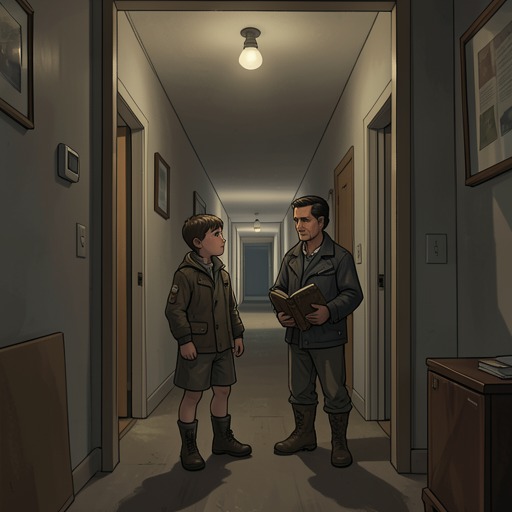
The DispossessedThe relationship between Shevek and Rulag joins a private rupture to a public argument about freedom. Rulag left when Shevek was two, while his father remained with him; years later, mother and son stand on opposite sides of a debate over contact with Urras. The separation helps explain the importance Shevek gives to loyalty, but neither their reunion nor their shared political setting erases the distance between them.
Separation and its legacy
Rulag’s absence began in Shevek’s early childhood. Takver later explains that Rulag left when he was two and that his father stayed with him. She does not claim that Shevek turns this experience into a general rule about who should raise children. Rather, she connects the loss to the importance loyalty has for him: Shevek feels that something essential was lost, and that he and his father both experienced that loss.
This history reaches the reader through other people’s observations rather than through a direct account from Shevek. Takver offers her interpretation of what the childhood separation meant to him; Bedap, learning that Rulag is Shevek’s mother, sees their resemblance and describes Rulag as having become hard. His judgment is strongly partisan, formed by his political opposition to her, but it reveals how the private fact of kinship alters his perception of both of them.
Rulag in the political dispute
When the Syndicate of Initiative considers admitting a small group of Urrasti to Anarres, Rulag emerges as one of its most capable opponents. She is an engineer, and Bedap recognizes in her a clear, pragmatic cast of mind as well as a dislike of complexity and irregularity. She opposes the Syndicate on multiple issues, including its right to exist. Bedap respects the quality of her arguments and sometimes finds himself persuaded by her warnings about Urras’s strength and the danger of negotiating from weakness.
Rulag’s case against opening the settlement is not merely personal hostility to the Syndicate. She argues that its transmitter, broadcasts, and publication of communications have proceeded against the advice of most of the PDC and amid protests from the Brotherhood. In her view, transmitting scientific information to a powerful outside society exposes Anarres’s weakness and risks harm to the community. She takes the prospect of visitors as a further escalation: a small group might be followed by larger numbers, commercial interests, and ultimately an armed presence. Her argument treats the Terms of the Settlement as the safeguard that has kept Urrasti off Anarres and preserved the settlement’s independence.
The immediate proposal is rejected. With most participants favoring adherence to the Terms of the Settlement, Bedap accepts that no Urrasti will arrive on the freighters under discussion. But he distinguishes that question from sending an Anarresti to Urras. Shevek speaks up in favor of the individual’s right to take an action that does not threaten anyone on Anarres, arguing that the Terms do not forbid such a departure and that the PDC would assume authority by prohibiting it.
Mother and son at the point of conflict
Rulag answers Shevek’s argument by emphasizing the danger of leaving: anyone can go, she says, but may not be able to return if the propertarians’ freighters will carry them out. Her warning is both practical and political. It raises the possibility that a journey permitted in principle could become a permanent separation, whether through restrictions imposed on Urras or refusal of a return landing on Anarres.
Shevek and Rulag’s disagreement sharpens when he defends individual initiative and the risks it entails. Shevek argues that Anarres was founded for freedom rather than safety, and that a society cannot remain alive and adaptable if individuals must always submit to majority rule. Rulag responds that he has no right to involve the community in a risk driven by private motives. Shevek answers that those unwilling to take the risk have no right to stop him. Their exchange makes the political dispute intimate without reducing it to family grievance: Rulag speaks as a member of the society whose safety she believes is at stake, while Shevek insists on the individual’s right to act.
The relationship’s history is disclosed in a later conversation between Takver and Bedap. Takver identifies Rulag as Shevek’s mother and explains the childhood separation; Bedap then interprets Rulag’s opposition through that knowledge, suggesting that guilt may be involved and that she resents the people close to Shevek. These are Bedap’s conjectures, not established explanations of Rulag’s motives. The passage instead underscores how little Shevek says about his mother and how kinship becomes newly visible to others after the political conflict has already taken shape.
The return question
Before leaving for Urras, Shevek tells Takver that he may not be able to come back. He names two possible barriers: the Urrasti might keep him, since people there are not free to come and go, or people on Anarres might refuse to let him land. He specifically recalls that some members of the PDC threatened that outcome and that Rulag was among them. The warning she gave in the council thus becomes a possible condition of their relationship: departure may mean not simply distance, but exclusion from home.
Takver says that Rulag knows how to deny the possibility of coming home. Shevek agrees, while adding that Rulag is not alone: many people could regard a traveler to Urras who tried to return as a traitor or spy. Their exchange locates the conflict beyond the two of them. Rulag’s opposition expresses a wider fear that contact will compromise the settlement; Shevek’s departure tests whether Anarres can preserve freedom without turning caution into a prohibition. Their relationship remains unresolved, carrying both the personal weight of an early separation and the political uncertainty of whether a son who leaves will be permitted to return.